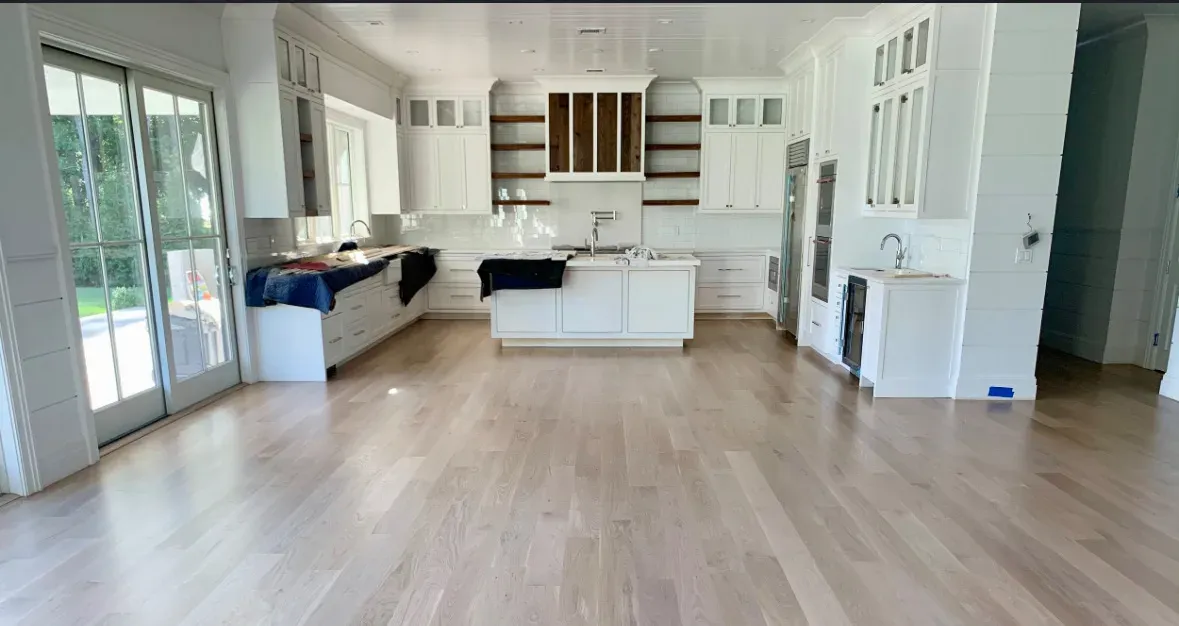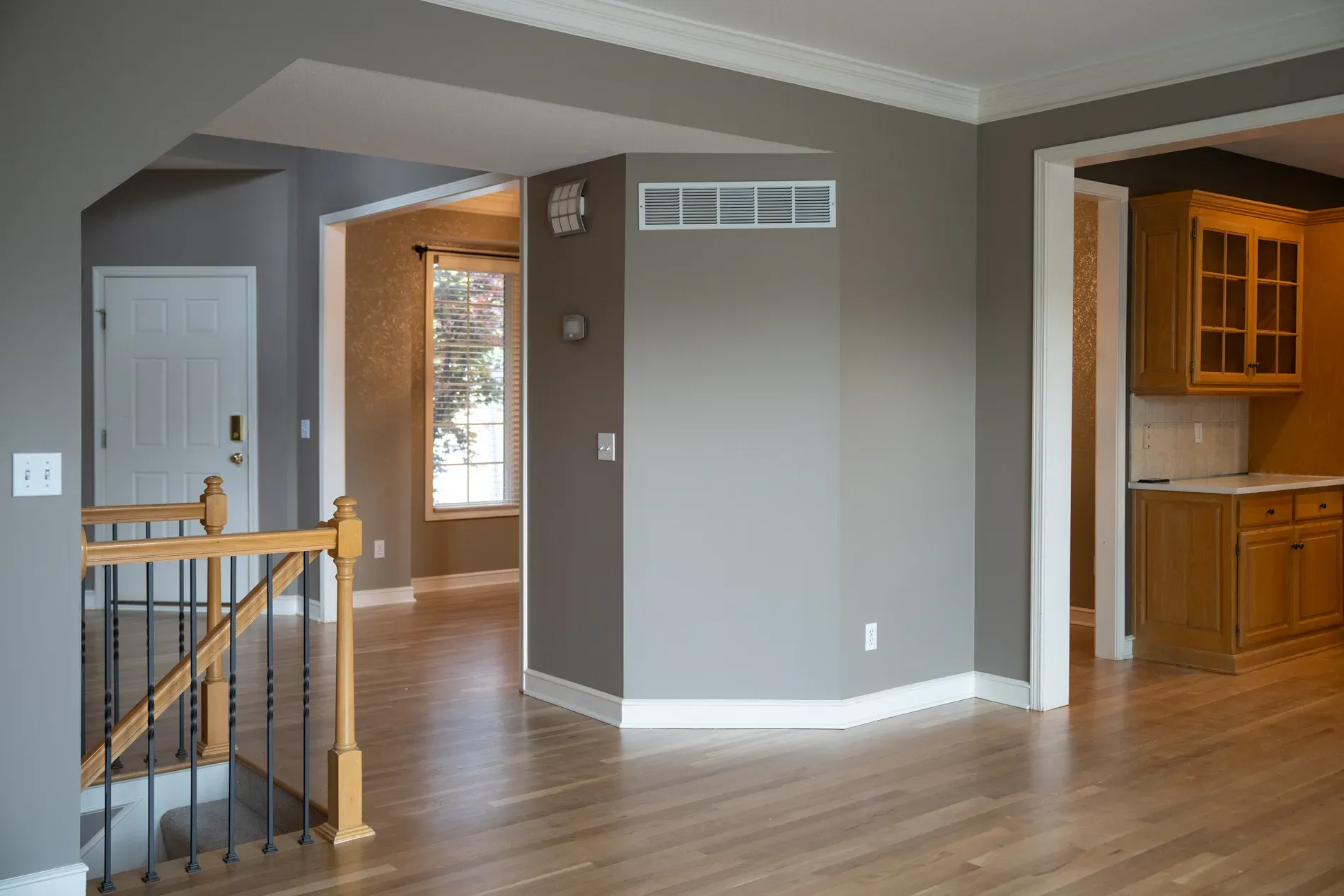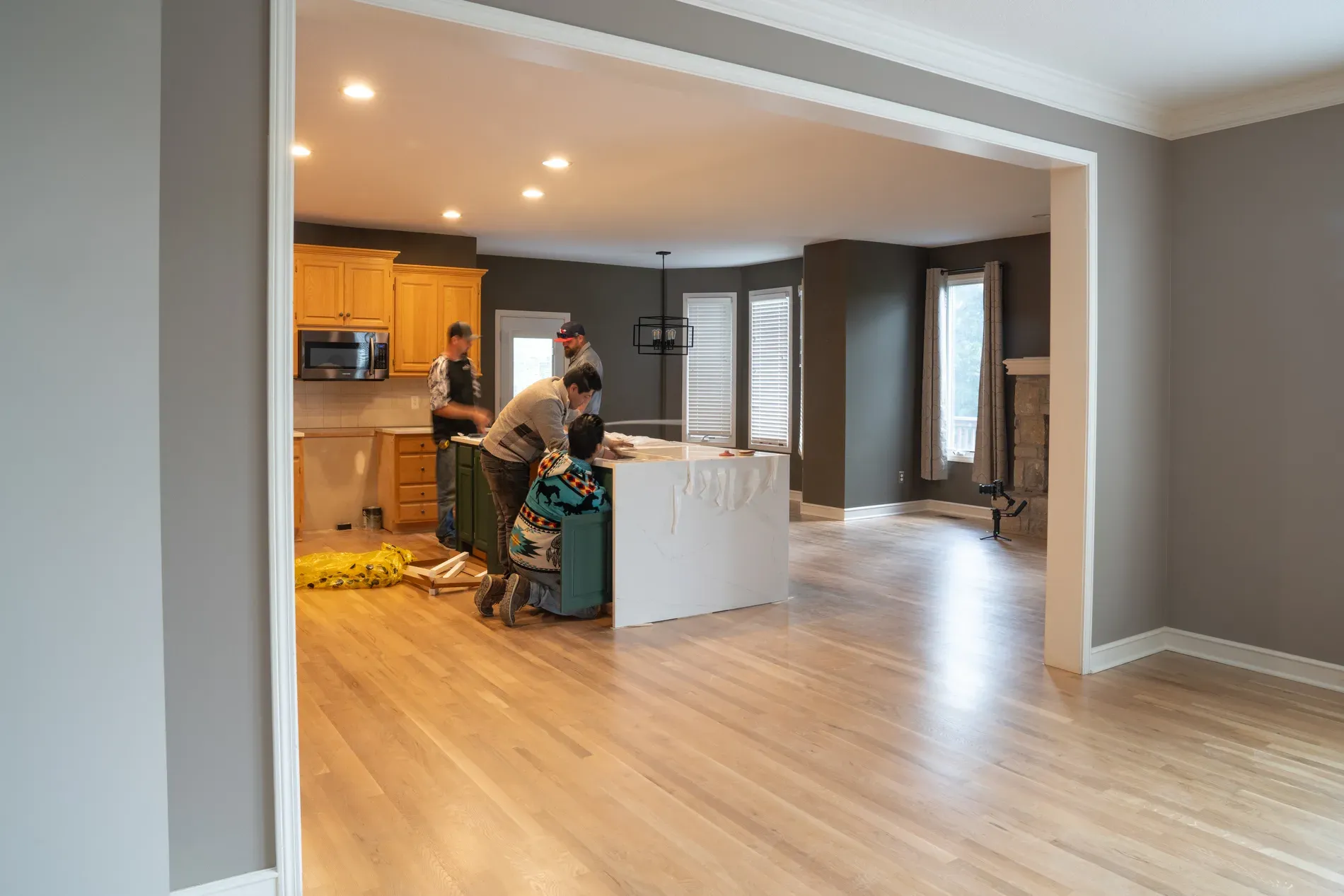
People searching for custom hardwood floors in Kansas City usually mean one of two things. Either they want a floor that does not look like the one in every new build in Johnson County, or they have something specific in mind, a border, a pattern, a width, a color, that they cannot find in a box at a flooring store. Both are legitimate, and both are things we do. But the word covers a lot of ground, and the parts of it that cost real money are not always the parts people expect.
This is a plain breakdown of what custom means in practice, so you can decide which of it you actually want before you get a quote.
Site-Finished Is the Foundation of Everything Custom
Almost every custom decision starts with one choice: unfinished wood, installed in your house, then sanded and finished in place. That is the opposite of prefinished flooring, where every board arrives with the factory's color and coating already on it and you pick from what the manufacturer offers.
Site-finishing gives you the flat, seamless surface that only happens when a floor is sanded as one piece after installation. It lets the color be decided on your floor rather than a sample chip. And it is the only way to lace new wood into old, run a border, or do anything that requires the floor to be finished after the boards are down. We compared the two approaches in prefinished or site-finished, and if you want anything on this page beyond a plain floor in a factory color, site-finished is where you start.
What it costs: more labor time than prefinished, because the sanding and finishing happen in your home, and a few days more with the room out of use. It does not, by itself, cost dramatically more in material.
Custom Color: The Cheapest Custom There Is
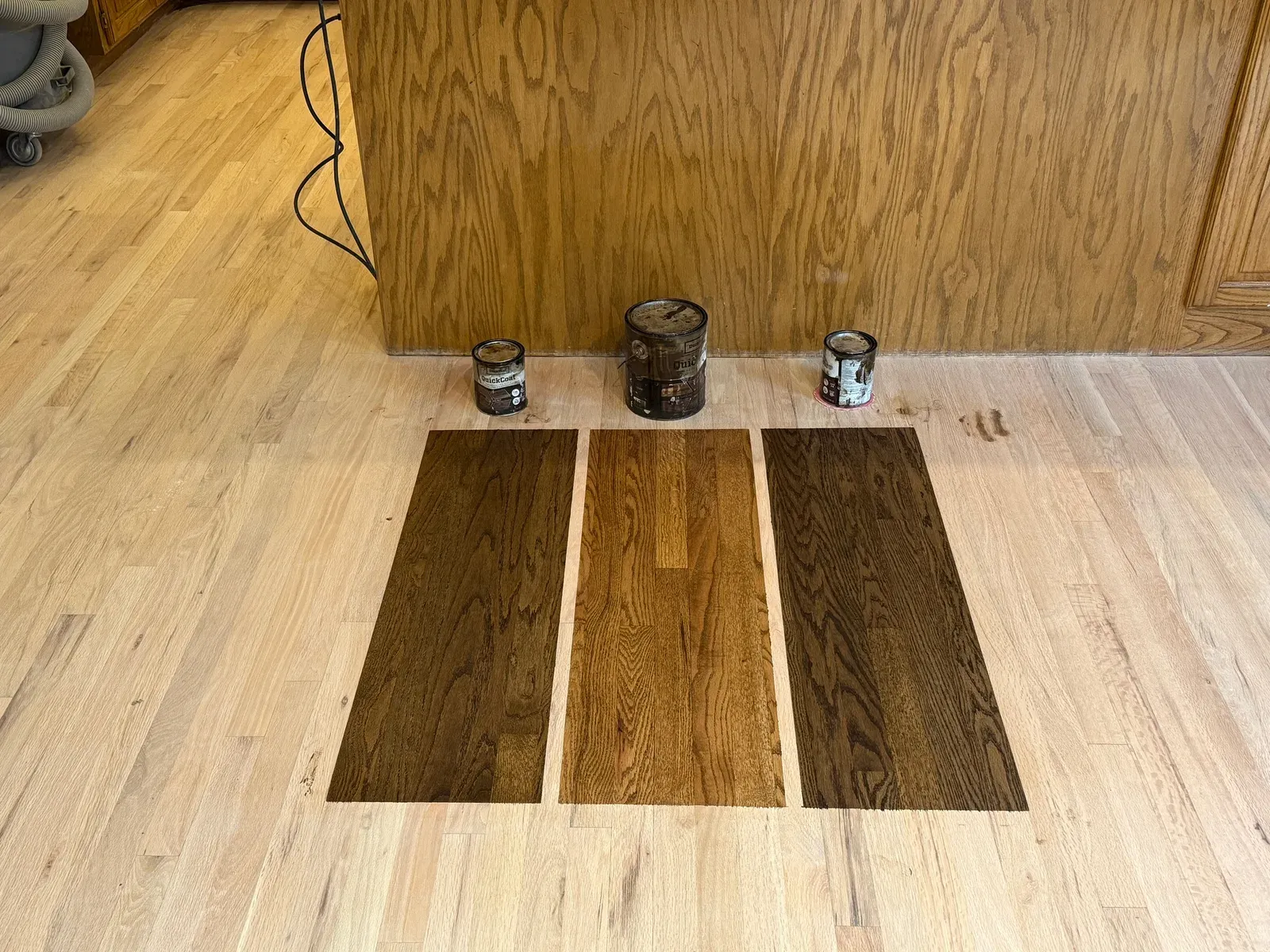
This is the one that surprises people. Matching a specific color, blending two stains, going darker or lighter than any stock option, or matching new wood to an existing floor elsewhere in the house, is ordinary work on a site-finished floor. The stain is mixed and tested on your sanded wood in your light, adjusted, tested again, then applied. There is no premium product involved. There is a bit more time on samples.
The one thing that costs more is a very light or very dark result on a species that resists it. Getting red oak to read gray, for instance, takes additional steps. The wood staining service page and the staining guide cover how the wood itself decides what colors are possible.
Species, Cut and Grade
Most of what makes a floor look custom rather than standard is decided at the lumberyard, not in the installation.
Species. Red oak is the default in Kansas City and it is a fine floor. White oak reads cleaner and more modern and is what most people asking for custom are picturing. Hickory, walnut and maple are all real options with real trade-offs, covered in choosing hardwood flooring.
Cut. Standard flooring is plain-sawn, which gives the familiar cathedral grain. Rift-sawn and quartersawn boards are cut so the grain runs straight and tight across the face, with a distinctive fleck in quartersawn white oak. It is the most stable wood you can put on a floor, it moves less across Kansas City's seasons, and it looks unlike anything from a big-box store. It is also the largest single price jump on this list, because far less of each log yields rift and quartered boards.
Grade. Select grade is clear and even. Number one and number two common carry more color variation, knots and mineral streak. Character grade is the current name for the rustic end. Grade is a looks decision, not a quality decision, and lower grades cost less, which is one of the few places custom can save you money.
Width and Length
Two-and-a-quarter-inch strip is the traditional Kansas City floor and it is what is in most older houses. Three-and-a-quarter, four, five and wider planks change the look of a room completely, and wide plank is a large part of what people mean when they say custom.
Two honest cautions. Wide solid boards move more with humidity than narrow ones, and Kansas City swings from humid summers to dry winters, so a wide solid plank floor will show more seasonal gapping than strip does. Beyond a certain width an engineered board is the better product, and we will tell you where that line is for the wood you want. And long boards, which matter as much as wide ones for the look, cost more per foot because they are the scarcer part of the log.
Mixed widths, meaning a repeating pattern of three-, four- and five-inch boards, is a genuinely custom look that costs mostly in layout time rather than material.
Borders, Inlays and Patterns
This is the traditional meaning of custom hardwood, and it is real craft work.
Borders. A band of contrasting wood, or the same wood run perpendicular, around the perimeter of a room or defining an entry. The field of the floor is laid, the border is cut and fit around it, and the whole thing is sanded flat. The cost is in the fitting, especially where a border has to turn corners cleanly or meet a stair.
Inlays and medallions. A feature set into the floor, usually in an entry or a dining room. Prefabricated medallions exist and are fit into a cutout in the field. Fully custom inlays are cut on site. Either way the floor has to be site-finished so it all ends up flush.
Patterns. Herringbone and chevron are the two people ask about, and they are the most labor-intensive floors we lay. Every board is cut to length, the layout has to be dead square to the room, and the sanding runs in two grain directions. We went through all of it in herringbone or chevron, and the herringbone flooring page covers the service.
Waste is the hidden cost across all three. A patterned or bordered floor throws away more wood in cuts than a straight-lay floor, so the material order runs higher than the square footage suggests.
Matching Stairs to the Floor
A custom floor with builder-grade stairs beside it looks unfinished. The staircase is where the custom decision most often extends: solid treads in the same species and cut as the floor, stained to match, and the railing, newels and balusters reworked so the whole thing reads as one design. That is its own trade, covered on the custom staircases and handrails page, and it is best decided at the same time as the floor so the material comes from the same order.
Matching New to Existing
The most common custom job in older Kansas City neighborhoods is not a border or a pattern. It is extending an original floor into a room that never had it, or replacing a damaged section so the repair disappears. That means sourcing unfinished wood in the same species and width as the original, sometimes in a milling profile that has not been standard for decades, lacing it in board by board, and sanding and finishing everything together. It is custom in the truest sense and the results are the ones we are proudest of. The installation page covers lace-in work.
Finish and Texture
The last layer of custom is the surface. Sheen, from matte to semi-gloss, is a free choice. Finish type, water-based or oil-based polyurethane or a hardwax oil, changes the look and the maintenance and is a real decision. Wire-brushed and hand-scraped textures exist mostly in prefinished products, though a site-finished floor can be brushed before coating. None of this costs much beyond the product itself, and all of it is decided in your house with samples on your floor.
Where the Money Goes, Summarized
- Small or no premium: custom stain color, sheen and finish type, lower grades, mixed widths, site-finishing itself.
- Moderate premium: white oak over red, wide plank, borders, matched stair treads.
- Large premium: rift and quartersawn cuts, long lengths, herringbone and chevron, inlays, full custom staircases.
The useful way to think about it is that most of what makes a floor look custom is decided by three choices, species, cut and width, and everything after that is craft time. We can build a floor at any point on that scale, from a plain white oak floor finished in your color to a bordered quartersawn entry with a matched staircase, and the free estimate is where we work out which parts you actually want. We do this work across the metro, from Leawood and Overland Park to the older homes in Kansas City proper.
Get a Free Estimate
Have a floor you want looked at? We give honest, no-pressure estimates across the Kansas City metro.