Every hardwood floor gets scratched. A chair leg, a dropped pan, a dog that took the corner too fast, a couch dragged six inches. What people want to know when they search for hardwood floor scratch repair in Kansas City is whether the mark they are looking at is a small problem or a big one, and the honest answer is that it depends entirely on how deep it goes. This guide is the decision tree we use when we look at a scratched floor, so you can run it yourself before you call anyone.
The Only Question That Matters: Finish or Wood?
A finished hardwood floor is two things stacked together: the wood, and a thin clear coating on top of it. A scratch either stays in the coating or goes through it into the wood, and everything about the repair follows from which.
Finish-only scratches show up as fine white or silvery lines. The wood underneath still has its color. Run a fingernail across the scratch and it barely catches. Get down low and the scratch disappears at some angles, because it is a groove in a clear layer rather than a change in the wood. These are the scratches from grit under shoes, chair glides, small dog nails on a polyurethane floor.
Scratches into the wood show a color change. On a stained floor the scratch is lighter than the surrounding boards because it has cut through the stain to raw wood. On a natural floor it is a visible groove with a raw edge, and your fingernail drops into it. These come from something sharp or heavy: a metal chair foot, a dragged appliance, a large dog, a dropped tool.
A quick test: put a drop of water on the scratch. If it darkens the scratch noticeably, water is reaching bare wood and the scratch is through the finish. If it beads and the scratch looks the same, it is in the coating.
Finish-Only Scratches: Three Fixes, Cheapest First
Clean and buff. Some very light scuffs are not scratches at all but marks on the surface of the finish. A proper hardwood cleaner and a soft cloth, or a buffing pad on a low-speed machine, takes them off. Worth trying first, and the cleaning guide covers what products are safe.
Spot recoat. A single scratch or a small cluster in an otherwise good finish can sometimes be abraded locally and a new coat feathered in. This works best on a matte or satin water-based finish, and it works poorly on a gloss finish or an older oil-based one, where the patch shows as a slightly different sheen. It is a maintenance-level fix, not a restoration, and we are honest about when it will show.
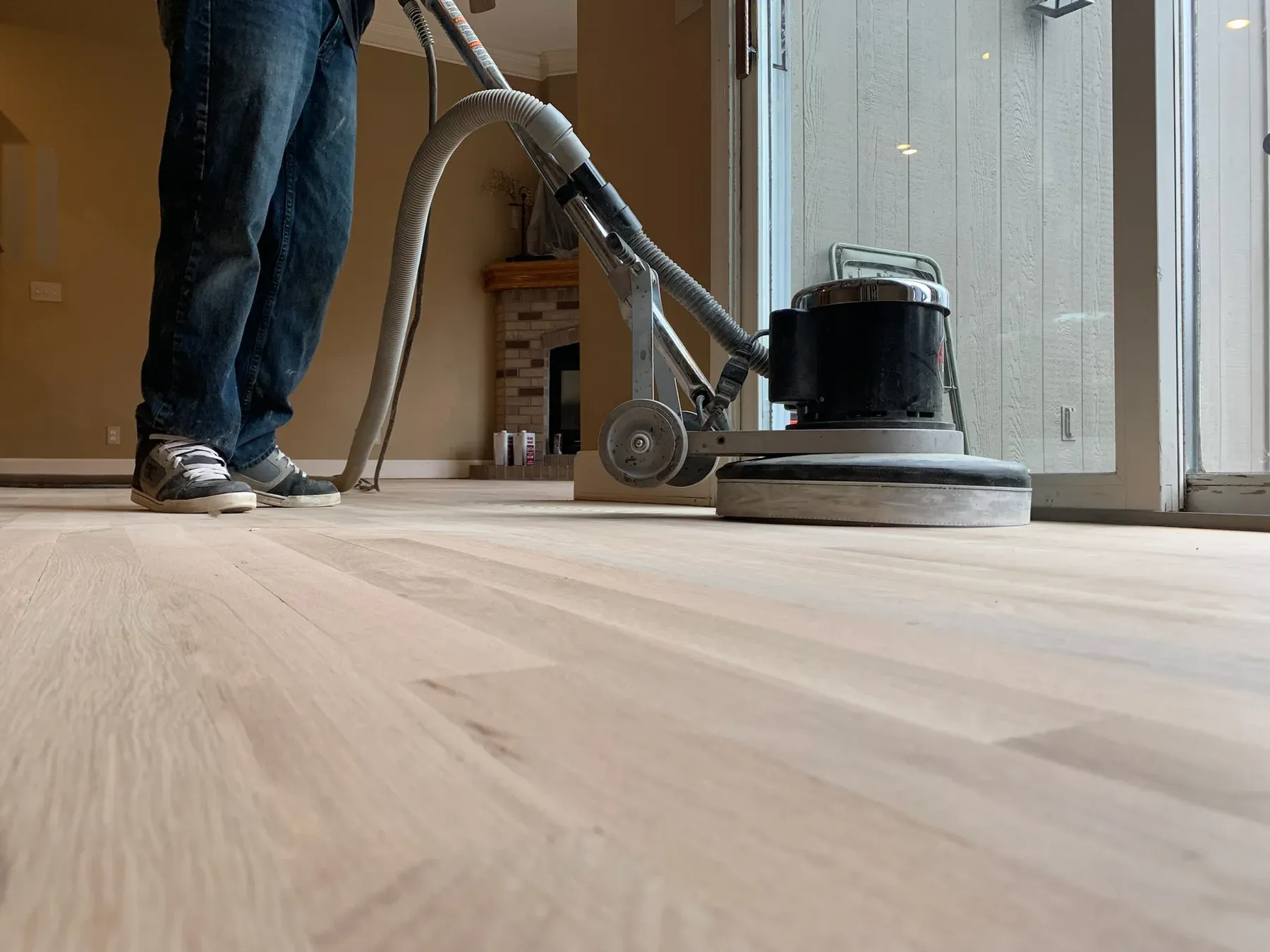
Screen and recoat the room. If the scratches are all over, which is how a floor looks after five years of a busy household, the right answer is to abrade the whole finish lightly and apply a fresh coat over the entire room. Every finish-only scratch disappears at once. No wood is removed, the color stays the same, and the floor is back in use in a day or two. It is the highest-value job we do and most floors should get one every several years before the scratches wear through. The screen and recoat guide covers when it works and when it does not, and the recoating service page has the details.
The one warning: a recoat only fixes scratches that are in the finish. If even a few have reached the wood, those will still be there afterward, sealed under new finish, and they will stay until the floor is sanded. Sort the scratches before you choose.
Scratches Into the Wood: It Depends on Where and How Many
Once a scratch has cut into the wood, the fix has to remove wood or fill it, and the question becomes how big an area you are willing to disturb.
A single scratch in a natural-finish floor. A shallow groove in unstained wood can be sanded out locally by hand, feathered into the surrounding boards, and recoated. On a matte natural floor this can be nearly invisible. On a glossier finish it shows as a patch.
A single scratch in a stained floor. Harder. The scratch is lighter than the floor because it went through the stain, and sanding it out locally means re-staining the spot to match, then recoating. Stain color matching in a small area is genuinely difficult, and the result is usually good from standing height and visible up close. For one scratch in a dining room most people live with that. For a scratch in the middle of an entry, they often do not.
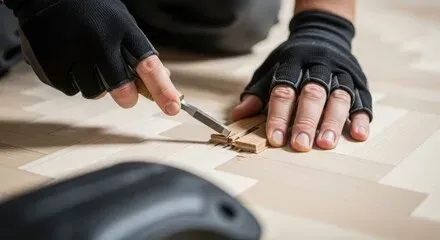
Deep gouges. A gouge that is too deep to sand out without creating a dip gets filled with a color-matched wood filler or, better, a sliver of matching wood glued in, then sanded flush and finished. Fillers are fine for small areas and they always look like filler if you are looking for them.
A board that is badly torn up. Replace it. A single board or a short run can be cut out and new wood laced in, then finished to match. It is the cleanest repair for serious damage and it is standard hardwood floor repair. The broader guide to what can be fixed versus replaced is wood floor repair.
Scratches into the wood all over the room. This is a refinish. Once the wood is scratched in enough places, no combination of spot repairs will look right, and sanding the whole room to fresh wood and finishing it again is both the better result and, per square foot, the better value. Plan for it as a room or a floor, not a patch.
The Blending Problem
Every spot repair on a hardwood floor has the same difficulty: the repaired area has new finish and the rest of the floor has old finish, and the two rarely match perfectly in sheen or color. Water-based finishes make this easier because they do not amber with age. Oil-based finishes darken over time, so a fresh patch reads lighter. Matte and satin sheens hide a patch. Semi-gloss and gloss show it.
This is why we often recommend recoating the whole room even when only one area has scratches. The extra cost over a spot repair is modest and the result is uniform. It is also why we tell people the truth about whether a spot repair will be invisible or merely acceptable, before we do it.
Prefinished Floors Are Different
A lot of newer Kansas City homes have prefinished hardwood, where each board came from the factory with its own finish and a small bevel at the edges. Scratches in these floors are handled differently.
Finish-only scratches on a prefinished floor can be recoated, but the factory finish has to be abraded correctly first or the new coat will not bond, and some very hard factory coatings are difficult to recoat at all. Ask before assuming.
Scratches into the wood on a prefinished floor are usually best handled by replacing the individual board. Because each board is finished separately and the bevels hide the joints, a replacement board from the same product line can be swapped in and is nearly invisible, which is a real advantage over site-finished floors for this one kind of repair. Keep a box of leftover flooring for this reason.
The manufacturer touch-up kits, pens and fillers sold for prefinished floors work reasonably on small marks and poorly on anything larger. They are a cosmetic fix, not a repair.
What Not to Do
- Do not use wax sticks, crayons or oil-based touch-up pens on a polyurethane floor unless you have decided that spot will never be recoated. Wax and oil contaminate the surface and new finish will not bond over them, which turns a small scratch into a small permanent problem.
- Do not sand a spot with power tools. An orbital sander in a small area cuts a dish into the floor that no finish will hide. Spot sanding is hand work.
- Do not mistake a mark for a scratch. Black heel marks, rubber scuffs and dried spills sit on the finish and clean off. Try cleaning first.
- Do not let a scratch into bare wood sit in a kitchen or entry. Water and dirt get into raw wood and turn a scratch into a gray or black stain that will need a board replaced rather than a scratch filled.
Preventing the Next One
Felt pads under everything that moves, a mat inside every exterior door, and keeping dog nails trimmed prevents most of the scratches we are called about. We covered the dog question specifically in dogs and hardwood floors. And a recoat every several years, before the finish wears through in the traffic paths, keeps scratches in the finish where they are cheap instead of letting them reach the wood where they are not.
Getting It Looked At
If you are not sure whether a scratch is in the finish or the wood, or whether one repair or a room recoat makes more sense, we will tell you straight. We handle scratch repair, board replacement and recoating across the metro, including Overland Park, Leawood and Kansas City. A free estimate is where we run the water test with you and give you the honest answer.
Get a Free Estimate
Have a floor you want looked at? We give honest, no-pressure estimates across the Kansas City metro.